 Official Government Website
The Idaho CPM® program is designed to offer public service professionals an opportunity to develop and improve their management and leadership skills.
- Courses are led by experienced public managers, skilled trainers, and university staff, blending proven theory with practical application.
- Participants learn alongside a diverse cohort, fostering collaboration and connections that enrich the learning experience.
Course Structure and Capstone Project
Participants in the CPM® Program progress through a structured learning experience that begins with twelve months of coursework followed by a dedicated capstone phase. During the coursework portion, participants attend classes two consecutive days each month, delivered either in person or virtually depending on their selected track. These sessions contribute to the program’s 300 total learning hours, which include classroom instruction, assignments, and applied learning activities.
Throughout the year, participants complete additional work outside of class that demonstrates how CPM® competencies are being applied in their daily roles. They also participate in regular office hours with other cohort members, where they receive guidance, reinforce learning, and engage in collaborative problem‑solving.
After completing the coursework portion, participants transition into the capstone phase. The capstone is a substantial applied project requiring approximately 50 hours of focused work and is designed to address a meaningful opportunity within their agency — such as cost savings, revenue generation, process improvement, or innovation. This final project showcases the practical integration of CPM® concepts and delivers measurable value back to the organization.
Idaho’s CPM® Curriculum
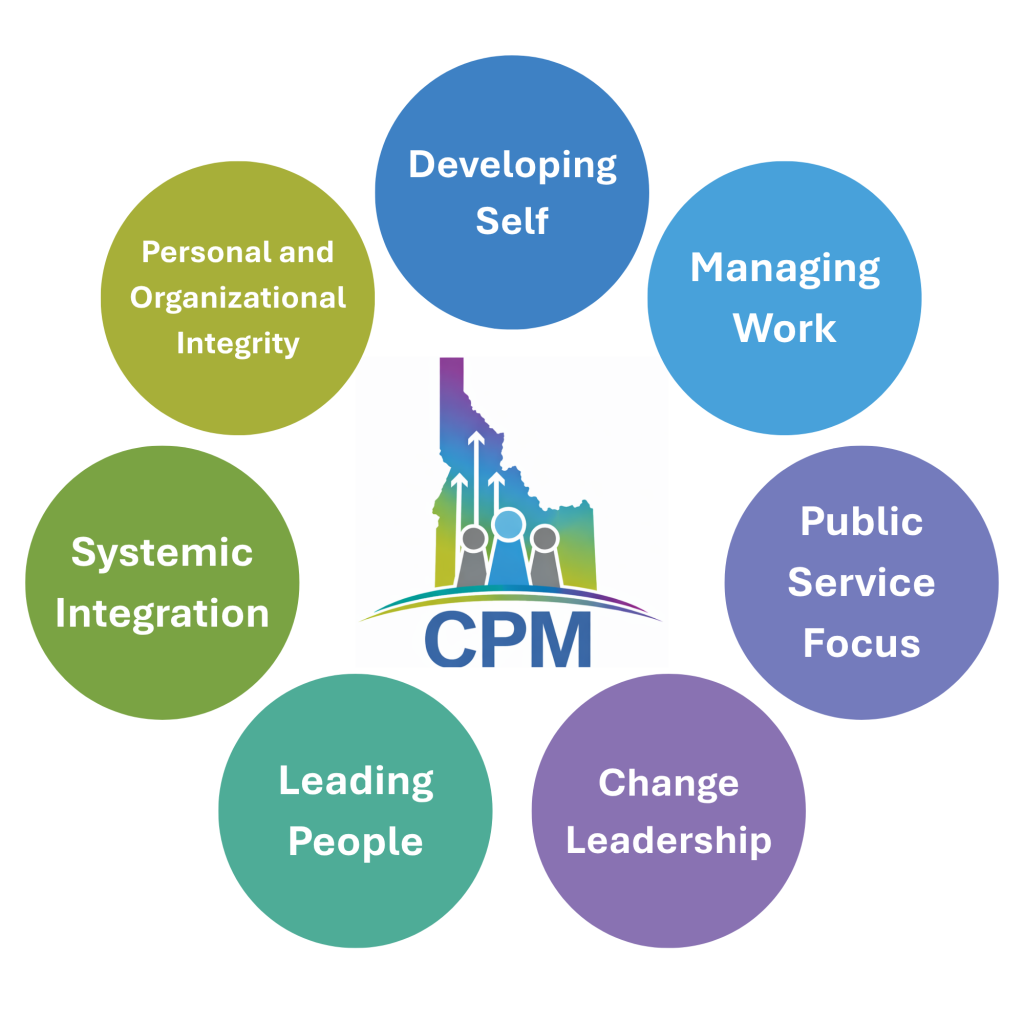
The curriculum is driven by these foundational competencies: